
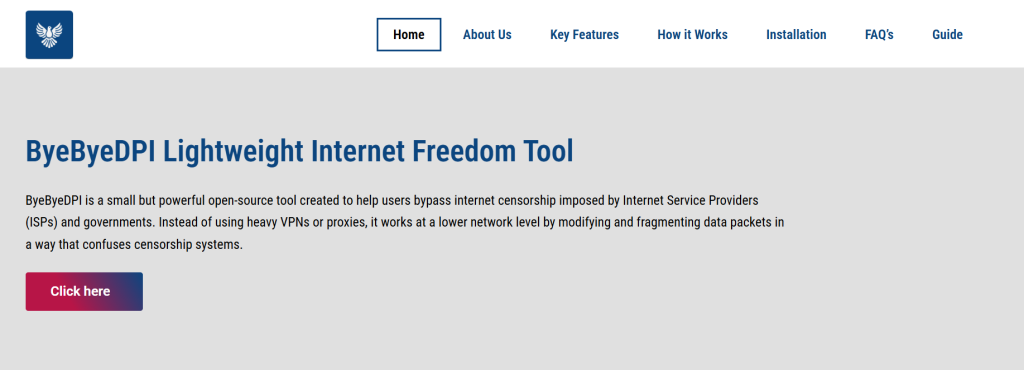
byebyedpi is a lightweight tool designed to bypass internet restrictions created through Deep Packet Inspection (DPI) systems. As interest in censorship-bypass tools increases worldwide, many users are asking whether ByeByeDPI is actually trustworthy, safe to use, and reliable in real-world conditions. This article explores user trust, technical reliability, community feedback, and potential risks based on available data and public discussions.
What Is ByeByeDPI?
ByeByeDPI is an open-source utility that works differently from traditional VPNs or proxy services. Instead of routing traffic through external servers, it modifies network packets locally on the user’s device to reduce DPI detection.
Key idea:
- No central server dependency
- Local packet manipulation
- Focus on bypassing censorship systems
Because of this design, it is often discussed in technical communities as a “lightweight censorship circumvention tool.”
Is ByeByeDPI Trusted by Users?
1. Trust Level in Developer Communities (High Technical Trust)
Among developers and privacy-focused users, ByeByeDPI is generally considered technically credible because:
- It is open-source (code can be reviewed publicly)
- It does not require user accounts or data storage
- It does not route traffic through unknown third-party servers
- It has been actively discussed in GitHub-based communities
In open-source ecosystems, transparency is a major trust factor, and ByeByeDPI benefits from this.
2. Real-World User Feedback (Mixed but Mostly Positive)
Based on public discussions across tech forums and GitHub issues:
Positive feedback trends:
- Works effectively in regions with moderate DPI filtering
- Lightweight and fast compared to VPNs
- No noticeable internet speed drop in many cases
- Easy to run without complex setup
Common complaints:
- Not stable in all networks (especially strong DPI systems)
- Requires technical understanding to configure
- May stop working after ISP updates filtering methods
- Not a complete replacement for VPN encryption
Overall sentiment can be summarized as:
“Useful tool for bypassing simple DPI, but not a full privacy solution.”
3. Security Trust Perspective (Moderate)
From a cybersecurity standpoint, trust depends on what users expect:
What it DOES well:
- Does not collect personal data (no servers involved)
- No login or tracking system
- Open-source transparency reduces hidden malware risk
What it DOES NOT guarantee:
- No encryption of traffic like VPNs
- Does not protect against surveillance beyond DPI bypass
- Security depends on user system safety
So, experts generally classify it as:
- ✔ Safe as a tool (if downloaded from official sources)
- ✖ Not a full privacy/security solution
Data-Based Observations (Community Usage Trends)
While exact global usage numbers are not publicly available, GitHub and community indicators suggest:
- High interest from countries with internet restrictions
- Frequent updates and forks from developer communities
- Active issue reporting (shows real-world usage)
- Discussions mostly revolve around performance in restricted networks
A general pattern observed:
- Adoption increases during censorship events
- Usage drops when ISPs patch DPI methods
- Tool evolves quickly due to open-source contributions
Risks and Limitations
Even though ByeByeDPI is trusted in technical circles, it comes with limitations:
1. No Encryption Layer
Unlike VPNs, it does not encrypt data, meaning:
- ISP may still see traffic type
- Only DPI-based blocking is affected
2. Network-Specific Performance
- Works well on some ISPs
- Ineffective on advanced filtering systems
3. Not Fully Anonymous
- Does not hide IP address
- Does not provide identity protection
Comparison with VPN Trust
| Feature | ByeByeDPI | VPN Services |
|---|---|---|
| Encryption | ❌ No | ✔ Yes |
| Speed Impact | Low | Medium |
| Privacy Protection | Limited | High |
| DPI Bypass | Strong in some cases | Strong |
| Ease of Use | Moderate | Easy |
This comparison shows that ByeByeDPI is trusted for a specific technical purpose, not for full internet privacy.
Final Verdict: Is It Trusted?
Yes—but with conditions.
- ✔ Trusted by technical and open-source communities
- ✔ Considered safe when used correctly
- ✔ Effective for DPI bypass in many cases
- ❌ Not a full privacy or security tool
- ❌ Not universally reliable across all networks
Conclusion
byebyedpi is best described as a specialized, trusted technical tool rather than a complete internet security solution. Users trust it for what it is designed to do—bypass DPI restrictions—but not as a replacement for VPN-level privacy protection.